North Richland Hills Wood Flooring works on wood flooring in Trophy Club after the water is already out of the house, which is the part of the job most homeowners have never had to think about until they are standing in it. We have spent more than twenty years on the flooring side of water losses, and it is a separate trade from the company that shows up with fans and dehumidifiers. Their finish line is a structure that reads dry. Ours starts there.
A supply line under a sink, a failed water heater, a slab leak or a sewer backup all end the same way for a hardwood floor: boards that have taken on water, and a slab or subfloor holding more of it than any finish will tolerate. What separates a repair from a replacement is rarely the size of the puddle. It is how long the wood sat wet and what the slab reads once the drying equipment is gone.
So we quote in a fixed order, repair first, refinish second, replace last, and we name the cheaper option out loud whenever it is the right one. That order only means something if the moisture numbers are real, which is why the readings come before the calendar.
The utility, the town, and where our part of the job begins
Water and sewer in Trophy Club come from Trophy Club Municipal Utility District No. 1, which is a separate governmental entity from the town itself. Town of Trophy Club Community Development is the building code authority. A water loss here therefore sits between two bodies that do not answer to each other, and homeowners regularly call the wrong one first.
Two authorities, two different phone calls
If the failure sits on the district’s side of the meter, it belongs to the MUD rather than to the town or to your carrier. If it is inside the house, the loss is yours and your insurer’s, and the district’s usage record is still worth pulling, because a jump in consumption can date a leak nobody in the house ever heard. We ask for that record whenever the timeline is going to matter to a claim.
The code in force, and the question we do not answer for you
The town adopted the 2021 International Residential Code along with the rest of the 2021 International Code family and the 2020 National Electrical Code, in effect as of April 2022. Trophy Club requires permits before new construction or any addition, alteration or repair of existing buildings, structures, plumbing, electrical or mechanical work, with limited exceptions for emergency work. Where a particular repair falls against that language is Community Development’s determination and not ours, so we send the scope to them before a start date goes on anyone’s calendar.
What a dry-out finishes, and what it leaves open
Restoration is not work we perform, and we are deliberate about that boundary, because the two trades get blurred in conversation and then in the scope of the claim. A restoration contractor is working toward a stable structure: framing, subfloor and slab brought back to a reading that says the house is no longer holding water. That is a legitimate finish line, and it is not the same thing as a floor that is ready to sand.
A floor can sit inside a structural dry standard and still be cupped, still be loose at the adhesive, still be over a slab whose perimeter has not come back. Boards that were soaked and then dried fast often hold a shape the finish will telegraph. We would rather keep a meter on it longer than sand a floor that is still moving.
Looking for wood-flooring closer to Grapevine? See Grapevine Wood-Flooring.
Reading slab moisture at the perimeter, not the middle of the room
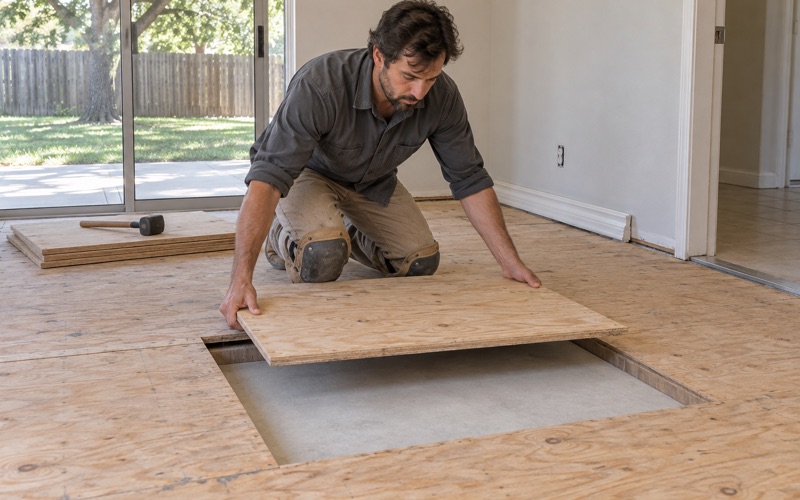
Most of the housing stock here is slab-on-grade, and a slab does not dry as one piece. Moisture arrives at the edges first and leaves them last, so a reading taken in the center of a room is the friendliest number in the house. We take ours at the perimeter, along exterior walls, and at any wall carrying a plumbing run.
Course-fronting lots carry irrigation right against the slab edge
Homes fronting the golf course have irrigation immediately outside the slab edge, which puts a perimeter moisture load on them that an interior lot in the same subdivision does not carry. That load is there before any pipe fails and it is still there after the drying equipment leaves. On those addresses we test the perimeter twice, days apart, rather than trusting one reading taken on a dry afternoon.
A recorded number before an installation date is set
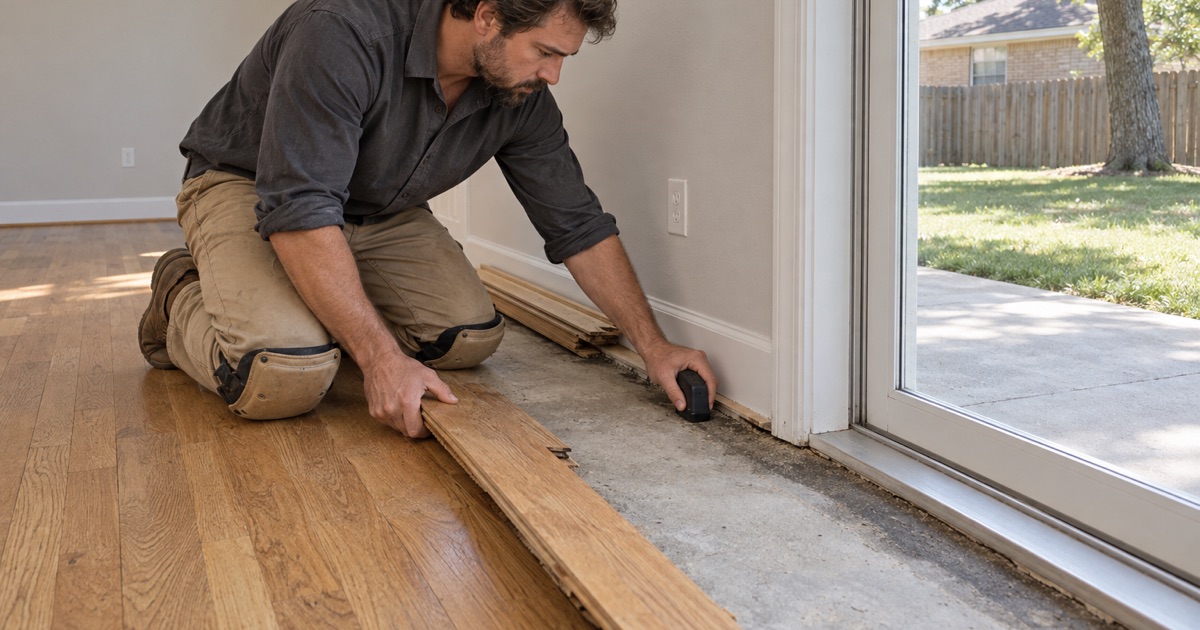
We test the slab to a recorded number before an installation date is set, not after the wood is already sitting in the driveway. On concrete that means an ASTM F2170 in-situ relative humidity test, or a calcium chloride test where the adhesive manufacturer wants a moisture vapor emission rate instead. The number goes into the file with the date and the exact location it came from.
If the perimeter will not come down, the wood and the adhesive are not the first problem to solve. We sequence our work after foundation repair and plumbing rather than ahead of it, so a new floor is not paying for somebody else’s schedule.
Wood acclimates inside the house, in the room it is going into, never in the garage and never left on the truck overnight. That matters more than usual after a water loss, because the house itself often runs humid for weeks afterward. Equilibrium moisture content is a moving target while the air is still wet, and installing into it is how a floor ends up cupped or gapped a second time.
Putting boards back into a floor that is already down
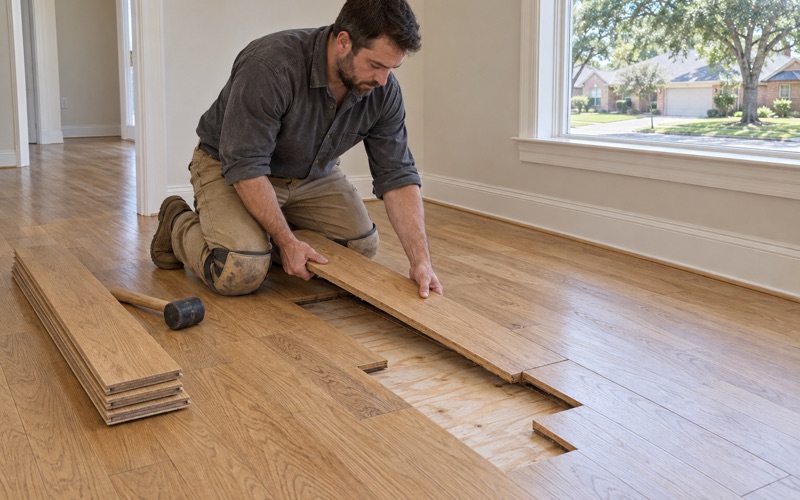
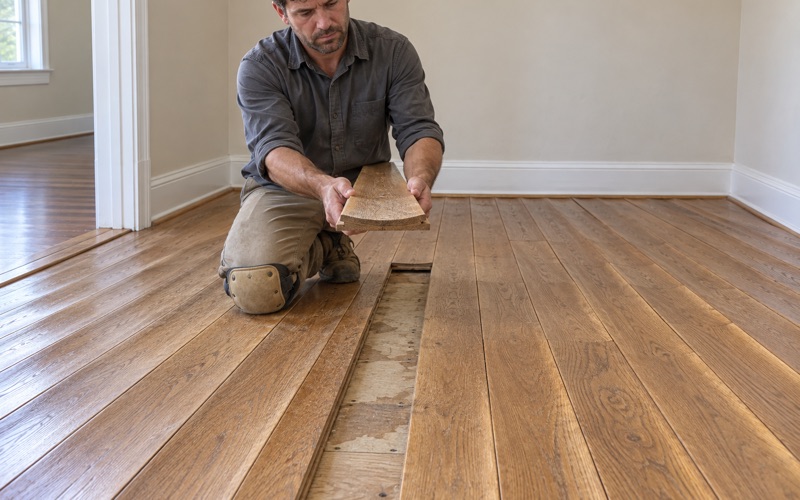
Where the wet area is contained, replacing the affected boards is usually cheaper and always faster than pulling a whole floor. The work is a weave-in, sometimes called lacing: damaged boards come out, new material goes back in staggered so the seams never line up, and the repair loses its outline. A dutchman patch covers a small localized spot where a full board run is not warranted.
Matching into a floor that has aged
Matching is rarely a question of species. White oak at 1360 on the Janka scale and red oak both take a weave-in the same way, and what a visitor actually sees is grain and color, not hardness. The harder problem is that the existing floor has been changing since the day it went in, and a finish that has sat under a south window for years is not the color it left the can as.
We ask for a leftover box from the original installation before anything else, and in an owner-occupied house it is often still in the attic. Where none exists we pull a board from a closet or from under an appliance to carry as a sample, then fill that spot with material out of the same repair.
Site-finished and prefinished are two different repairs
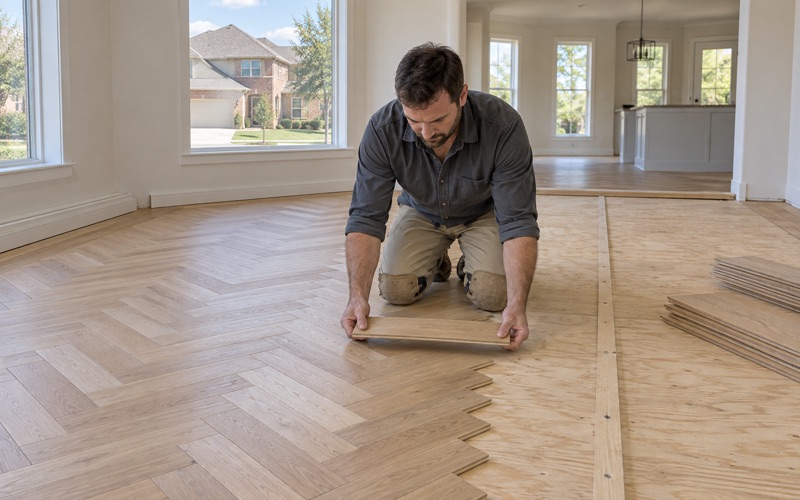
On a site-finished floor the fix is straightforward in principle: weave the boards in, then sand and coat the whole continuous area so old and new go under one finish together. A prefinished floor has no such step, so the match has to be made at the board, and the run, the gloss level and the milling profile all have to agree. Where the original product is gone from the market we say so before we take the job rather than after.
Continuous flooring is the phrase that decides scope on a claim, and it is worth understanding before an adjuster uses it. If the floor runs unbroken out of the wet room and into the next one, with no threshold or transition breaking the line of sight, the repairable area is not the puddle, it is the run. We map that line of sight and photograph it rather than argue about it later.
Refinishing a floor that has already been wet, and when it has to come out
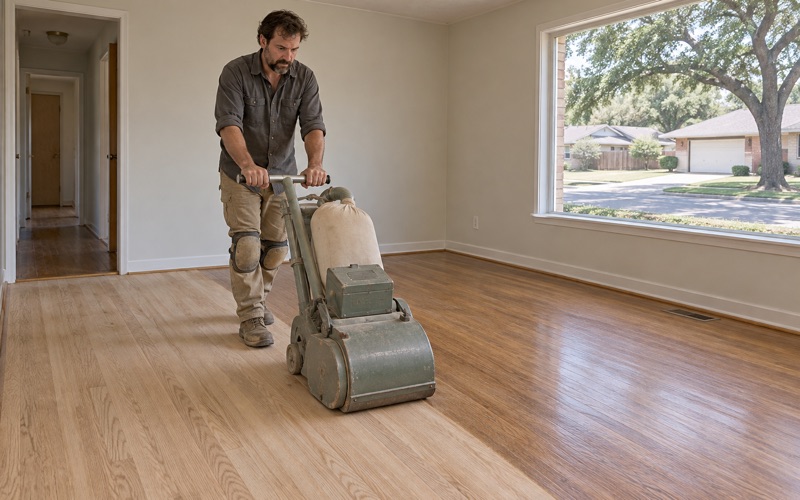
A floor that got wet and came back down is often refinishable, and where the damage stopped at the finish a screen-and-recoat is sometimes the whole job. Where boards cupped, the sanding has to take the crown off flat, which is a full 36-50-80 grit sequence with a drum sander in the field, an edger at the walls and a buffer before the first coat. Sanding a cupped floor too early shaves the high points off boards that still intend to move, and the floor crowns later.
Dustless containment goes up on every sanding job, and we set it up and show it to you before the first machine runs. One crew carries the work from tear-out through the final coat, and the sanding is never subcontracted out.
Engineered flooring has a budget you can measure
On engineered flooring we measure the wear layer before quoting a refinish at all. Below roughly three millimeters there is not enough veneer left to sand without risking sand-through to the plywood core, and a two millimeter wear layer is a recoat candidate at best. A six millimeter wear layer leaves real room, so this is a measurement rather than an opinion.
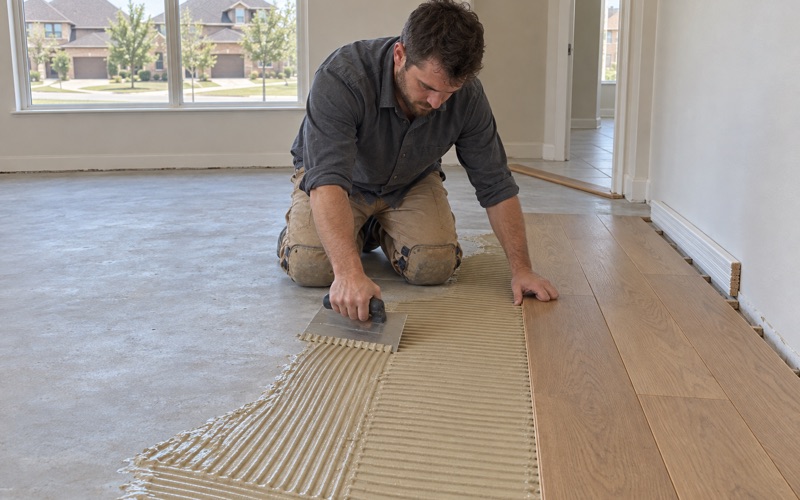
Delamination and adhesive bond failure are the two findings that usually end the repair conversation on a glue-down floor. Both announce themselves underfoot, because a hollow spot means the bond is gone whatever the surface still looks like. Buckling, where boards have lifted clear of the substrate, is the same verdict arriving from the other direction.
Finish choice after a water loss is partly a schedule decision
Waterborne polyurethane over a sanding sealer puts the room back in use sooner. Oil-modified polyurethane takes longer to cure and ambers as it ages, which sometimes helps a match into an older red oak floor, and hardwax oil makes a future spot repair easier in exchange for more maintenance.
Cure time and dry time are not the same number, and the gap between them is where new finishes get ruined. We hand over a written cure and occupancy schedule before the first coat goes down, including when pets and furniture come back into the room.
Documenting the loss for the claim file
Trophy Club is heavily owner-occupied: 4,195 of 4,757 occupied units are owner-occupied against 562 rented, or 88.19 percent. Most of these decisions are made by the person who has to live on the floor afterward rather than by a manager working backward from a turnover date, and the conversation about schedule changes accordingly.
We document water damage for the claim file room by room, with photographs, moisture readings and a line-of-sight map, because an adjuster pricing in Xactimate is working from a description somebody else wrote. Whether a loss reads as sudden and accidental water damage or runs into the gradual leak exclusion is the carrier’s call, and the file we hand over is meant to put that call on recorded facts. Actual cash value against replacement cost is the other line worth reading in your own policy before you agree to any scope.
- 20+ Years Experience
- Dustless Containment
- Free Written Estimates