
North Richland Hills Wood Flooring installs solid hardwood flooring in North Richland Hills, TX, serving surrounding cities including Watauga, Hurst, Haltom City, Colleyville and Bedford. Solid hardwood is the floor that can be sanded back and recolored several times over its life, which is the whole argument for it — and it is also the floor with the most demanding requirements about what sits underneath it.
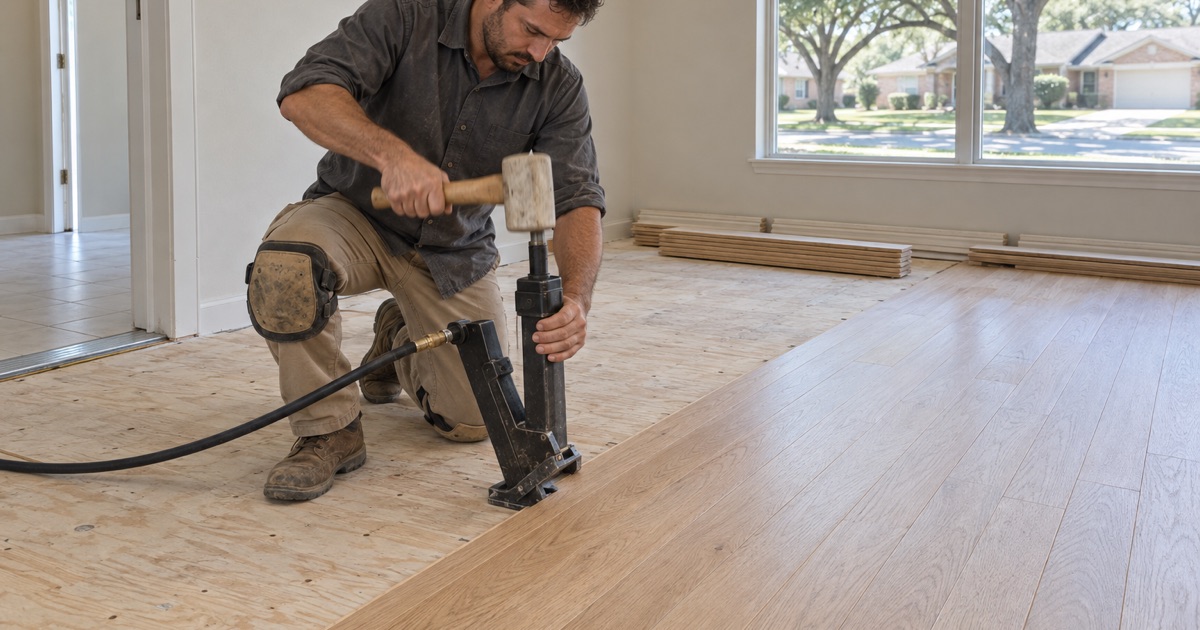
The requirement is a nailable deck. A solid board is fastened mechanically, so unless the house has a framed floor there has to be a plywood sleeper frame or a floating plywood subfloor system built over the concrete first. That is entirely achievable and it costs height, which then affects doors, appliance openings, cabinet toe kicks and the first stair riser. We work out that stack-up before the method is chosen rather than after the sleepers are down.
The second requirement is moisture discipline. Solid wood moves across its width with the humidity around it, so the material acclimates inside the house, in the room it is going into, at the conditions the house actually runs at — never in the garage and never left on the truck. We check its moisture content against the subfloor before a board is fastened, because wood installed at the wrong content moves afterward instead of before.
What Solid Hardwood Needs Underneath It
A Nailable Deck, and How to Get One Over a Slab
Where the house is framed, the deck already exists and gets checked for joist spacing, panel thickness and fastener hold. Where it is slab-on-grade, we build one: sleepers fastened to a conventionally reinforced slab, or a floating plywood subfloor where the slab is post-tension and nothing may enter it. The choice follows the slab classification, which we establish at the property.
Cleats, Staples and the Fastener Schedule
Nail-down installation uses cleats or staples driven at an angle through the tongue, and the two behave differently — cleats allow a little seasonal movement, staples grip harder and forgive less. Gauge, crown width and spacing are set by board width and thickness rather than by preference. Following that schedule is most of what separates a quiet floor from one that develops squeaks.
Moisture, Acclimation and Equilibrium Moisture Content
Wood settles toward an equilibrium moisture content determined by the air around it. We meter the boards and the subfloor and install only when the two are within an acceptable spread, after the material has spent its acclimation period in the room itself. That single discipline prevents most of the gapping, cupping and consumed expansion gap that gets blamed on the wood later.
Choosing the Board
Species and Janka Hardness
The Janka hardness rating measures resistance to denting: white oak at 1360 Janka, red oak just under it, hickory at 1820 Janka, and maple harder than red oak but much less forgiving of stain. Red oak’s open grain hides wear and takes stain evenly. Maple’s tight grain blotches unless it is sealed carefully or left clear, which is a decision worth making before the material is ordered.
Grade, Board Width and Milling
Grade describes how much knot, mineral streak and color variation the boards carry, not how strong they are. Narrower boards break that variation up; wider ones display it. Milling quality shows in how consistently the tongue-and-groove fits and how flat the boards lie, and it is the difference that only becomes obvious during installation, when a poorly milled bundle costs a day of fighting it.
Prefinished Against Site-Finished Solid
Prefinished boards arrive cured with a micro-bevel at each edge and take traffic immediately. Site-finished floors are sanded flat after installation and coated as one continuous surface with no bevels, which is what allows a lace-in repair to disappear years later and what lets you pick a color against the actual wood. Both are legitimate; the repair plan usually decides it.
What Solid Hardwood Buys Over Time
Sanding Depth Above the Tongue
The usable wood on a solid board runs from the surface down to the tongue, and that depth is what every future refinish spends. It is readable at a vent cut or a doorway on an existing floor, and it is the number that tells you whether a floor has decades of refinishes left or is on its last one. We read it before quoting any refinish rather than after the drum sander is running.
Board Replacement and Invisible Repairs
Because a site-finished solid floor is one continuous coated surface, damaged boards can be cut out and new ones woven into the field so the end joints stagger naturally, then sanded and coated with everything around them. That is the repair that genuinely disappears. It is available to solid floors in a way it is not to prefinished or thin-wear-layer engineered ones.
Refinishing, Recoating and Changing Color
A solid floor can be screened and recoated when the damage is in the finish, sanded fully when it is in the wood, and stained a different color entirely when the room changes around it. Waterborne polyurethane keeps a light or gray tone clear; oil-modified ambers warmly over a red oak floor. Having that choice available in fifteen years is the real return on solid hardwood.
Where Solid Hardwood Is the Wrong Answer
Post-Tension Slabs and Height Constraints
On a post-tension slab no fastener enters the concrete, so solid hardwood needs a floating plywood deck built over it, and that height is sometimes simply unavailable — a low ceiling, a door that cannot be trimmed, a stair riser that would fall out of tolerance. Where the stack-up does not work, a glue-down engineered floor is the better answer and we say so.
Below-Grade and High-Moisture Areas
Solid wood does not belong in a space where moisture arrives from below or where humidity swings hard and cannot be managed. Engineered construction handles those conditions because its cross-laminated core restrains movement. Recommending solid into a room that will fight it produces a callback rather than a floor, so we route those spaces to a different product.
Rooms Where Humidity Cannot Be Controlled
A house left unconditioned for long stretches — a seasonal property, a vacant rental between tenants, a space heated only when occupied — puts solid wood through repeated large moisture swings. Seasonal gapping in that setting stops being cosmetic. We ask how the house is actually run before recommending a wide solid board into it.
- 20+ Years Experience
- Dustless Containment
- Free Written Estimates