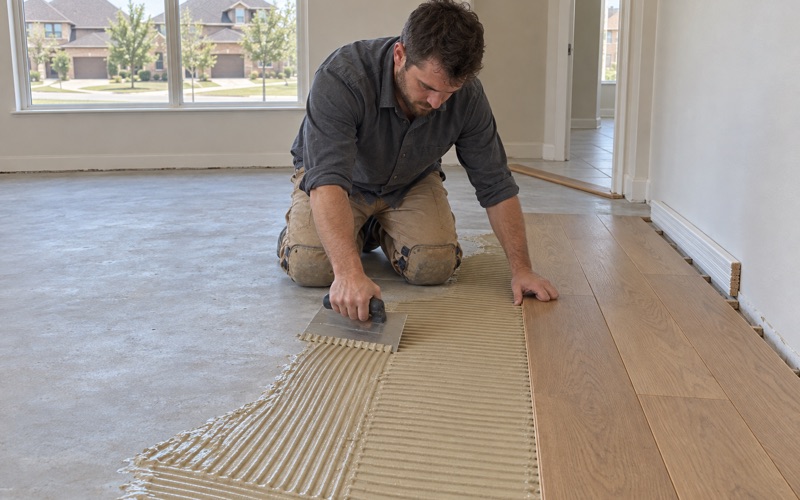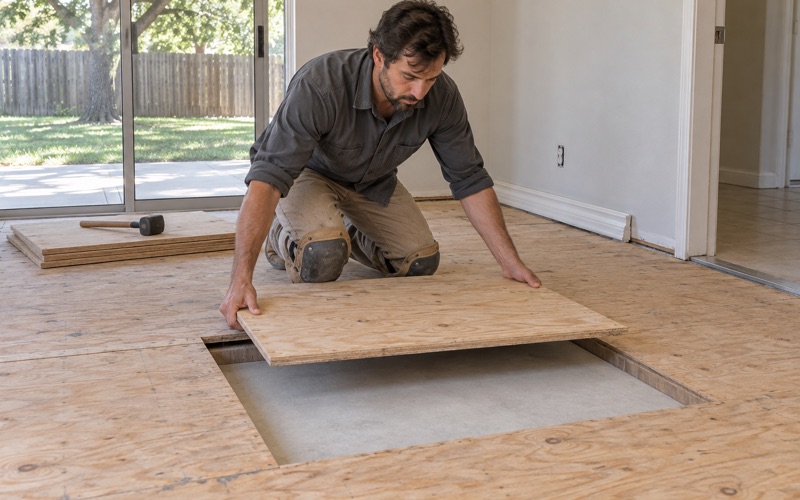
North Richland Hills Wood Flooring has been installing, refinishing and repairing wood flooring in Roanoke for more than twenty years. Two very different jobs account for most of what we are called out for here. One is a floor that people walk on all day because they are paying to be in the room, and the other is a floor a family lives on.
That distinction drives almost every decision downstream, from species and finish chemistry to how often a floor gets recoated and which hours the work can happen in. We price repair, refinish and replacement in that order, and we name the cheaper option first whenever it is the right one. On engineered flooring we measure the wear layer before quoting a sand and finish at all, because below about three millimeters there is nothing left to take off.
One crew carries the job from tear-out to final coat, and we never subcontract the sanding. You get a written cure and occupancy schedule before the first coat goes down, covering when furniture, pets, and on a commercial floor the tables and chairs, come back into the room.
What Oak Street asks of a floor
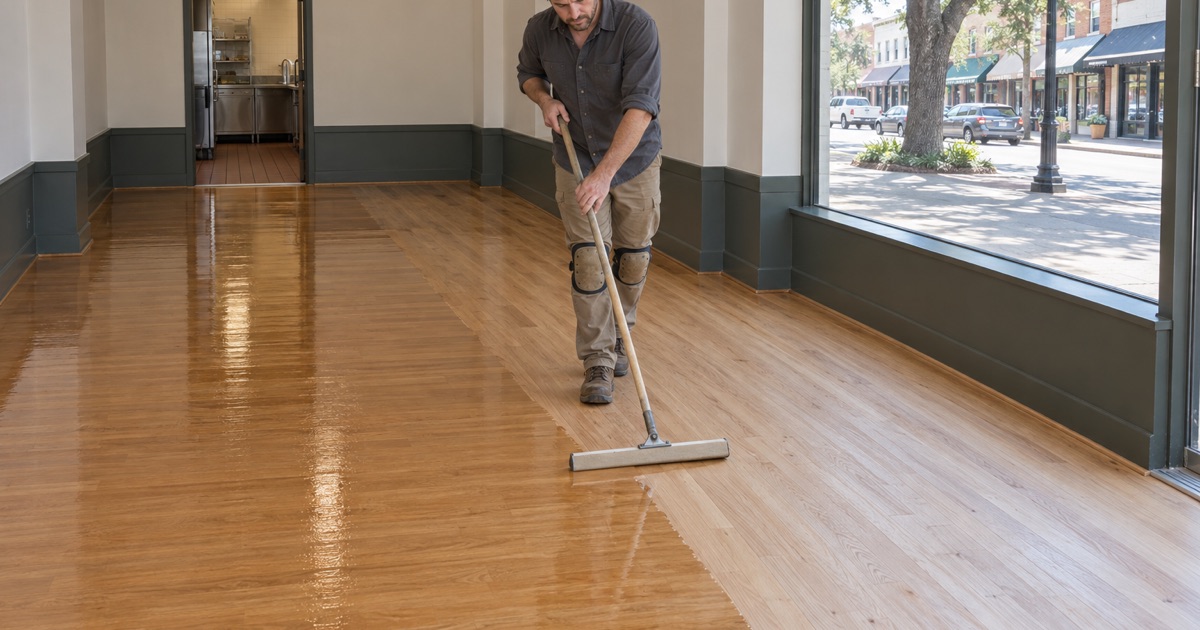
Some of the hardest-worn wood floors we are asked to look at in Roanoke are on Oak Street. The Texas House of Representatives named Roanoke the Unique Dining Capital of Texas in 2009, and the restaurant concentration behind that title sits along a corridor the city has been rebuilding since the 2004 Roanoke Downtown Plan. The American Planning Association named Oak Street a Great Street designee in 2020. A dining room works a wood floor harder in one season than a living room does in a year.
Chair traffic, grease and spills
Restaurant wear is not spread evenly the way household wear is. It concentrates in the lanes servers walk, at the host stand, along the pass, and in the arcs chair legs scrape as guests push back from a table. Grease carried out of the kitchen on shoe soles works into those same lanes and changes how the finish behaves long before any board is damaged.
Grit tracked in from the sidewalk does more cutting than any single spill. A floor near the entry works like sandpaper under every shoe until the walk-off matting is long enough to catch it, and we will tell you where that matting needs to sit before we quote a recoat interval.
That pattern is good news if it is caught early, because the damage is still in the finish rather than in the wood. A screen-and-recoat with a buffer refreshes the lanes and leaves the boards alone. Once a lane wears through to bare wood, spills reach the fiber, the area darkens, and the fix becomes a full sand and finish instead.
Species, hardness and what hardness does not fix
Species selection on a commercial floor comes down to the Janka hardness rating and how the room actually gets used. White oak at 1360 Janka takes dents better than much of what gets specified for dining rooms, and hickory at 1820 Janka takes them better still, at the cost of a busier grain. Red oak and maple both belong in the conversation, and maple in particular displays a scratch pattern that oak hides.
Hardness resists denting, and it does nothing at all for finish wear, which is what fails first in a dining room. That is why we treat the finish system and the recoat interval as the durability decision and the species as the appearance decision. Where a few boards have taken localized damage, a board replacement, a weave-in or a dutchman patch is usually a better answer than sanding an entire room.
Board width and sheen matter as much as species under service lighting. A satin or matte finish scatters the scratch pattern that a gloss finish puts on display, and a wider plank leaves fewer seams for grease to collect in. Those are appearance calls with maintenance consequences, so we make them with the operator rather than for them.
Looking for hardwood floor repair closer to Arlington? See Arlington Hardwood Floor Repair.
Finish systems built for commercial traffic
Commercial-duty finish work is a different specification from residential, and the difference is mostly about return to service. A dining room cannot be closed for as long as a house can, so the schedule has to be built from cure time rather than dry time, and those two are not the same number.
Waterborne, oil-modified and hardwax oil
Waterborne polyurethane is the usual choice where the room has to reopen quickly and the owner wants the wood to hold its current color. Oil-modified polyurethane ambers over time and takes longer to reach service hardness, which suits a floor that can be handed back on a slower schedule. Hardwax oil sits lower in the wood and can be spot-repaired in a worn lane without recoating the whole room, which is worth real money on a floor that wears unevenly.
All three sit under the federal AIM rule at 40 CFR 59 Subpart D, which caps varnish at 450 grams per liter and sanding sealer at 550 grams per liter. We tell you which system we are using and what it means for your reopening date before anything is ordered.
Recoating on a schedule instead of refinishing after failure
The cheapest maintenance plan for a hard-worn floor is a recoat interval that is set and then kept. A screen-and-recoat costs a fraction of a full refinish, closes the room for a fraction of the time, and can be repeated many times over the life of a floor. Waiting until the finish has failed converts that small recurring job into a full sand every time.
Setting the interval is a judgment about traffic rather than a calendar rule, so we would rather look at the floor than guess at it. We walk the lanes, check whether the finish is still continuous under a light held low, and set the next date from what we see.
When a full sand is unavoidable we run a 36-50-80 grit sequence with a drum sander, work the perimeter with an edger, and blend with an orbital sander before the buffer. On engineered plank the risk in that sequence is a sand-through to the plywood core, which is the other reason the wear layer gets measured first.
Historically significant structures and the 2023 code set
The Oak Street Corridor zoning district emphasizes urban form over land use, and it requires site plan review of historically significant structures. Work on one of those buildings runs through that review track, which is separate from the ordinary residential path. We plan interior scope, staging and delivery around review timing rather than assuming a start date and hoping.
Older buildings also change the physical work. Framing can be out of level by modern tolerance, subfloors have often been patched by several generations of trades, and the thresholds where old floor meets new have to be resolved board by board rather than with a stock transition. We flag all of that at the walkthrough, because it is the part that moves a schedule.
The code editions Roanoke has adopted
In 2023 the city adopted the 2021 International Residential Code by Ordinance 2023-122 and the 2023 National Electrical Code by Ordinance 2023-119, as part of a set of ordinances adopted together. City of Roanoke Building Inspection, inside Development Services, is the authority working from that set. We detail transitions, thresholds and expansion gaps to the code edition the city has actually adopted rather than to a national default.
Sequencing around the rest of the job
Floor boxes and outlets in a dining room are electrical work that has to be complete before the floor closes over it, which is where the adopted electrical code meets a flooring schedule directly. We also sequence flooring after foundation repair and plumbing rather than ahead of them, so a new floor is not paying for another trade’s timeline. On a working restaurant that ordering is the difference between one closure and two.
Logistics on a block like this have little to do with the floor itself. Deliveries, dumpster placement and machine noise all have to fit around neighboring businesses that are open, and on a shared wall a sanding day is felt next door. We put the loud stages in the hours the block can absorb them.
Houses off the corridor
Away from the dining corridor the work is residential, and Roanoke’s housing record reads younger than its downtown does. That record counts no units built before 1950, and 53 units built in the 1960s. The historic character here is commercial rather than residential, so a homeowner here is more likely to be dealing with a worn modern floor than a century-old one.
Older houses and lead-safe work
On any house built before 1978 we use lead-safe work practices, including containment and cleaning verification at the end. Sanding is precisely the activity the EPA RRP lead-safe rule at 40 CFR 745 Subpart E is written around, and the six square foot minor repair threshold does not cover a room of floor. We set that up whether or not anyone asks for it.
Dustless containment goes up on every sanding job we run, not only the older ones, and we show you the setup before the first machine starts. Wood acclimates inside the house, in the room it is going into, never in the garage and never on the truck.
Before we set an installation date we test subfloor moisture and record the number, rather than testing once the wood is already sitting in the building. A number on paper is what tells us whether the floor can go down on schedule or whether the schedule has to move.
Turnovers, rentals and claims
Roanoke carries a substantial rental population: 1,976 of 4,323 occupied units are renter-occupied. Turnover work between tenancies is its own category of job, with a fixed date at the end of it rather than a flexible one. We schedule those backward from the inspection date instead of forward from ours, so the unit is finished when it has to be finished.
When a floor comes to us through an insurance claim, we document the water damage room by room with photographs, moisture readings and a line-of-sight map. That record is what an adjuster reads, and continuous flooring across a line of sight is the part of a claim most often argued over.
Whether the floor sits under a dining room on Oak Street or under a family in a house a few blocks off it, the sequence is the same: measure first, name the cheapest option that actually works, and hand over a schedule you can plan around. That method does not change with the address.
- 20+ Years Experience
- Dustless Containment
- Free Written Estimates