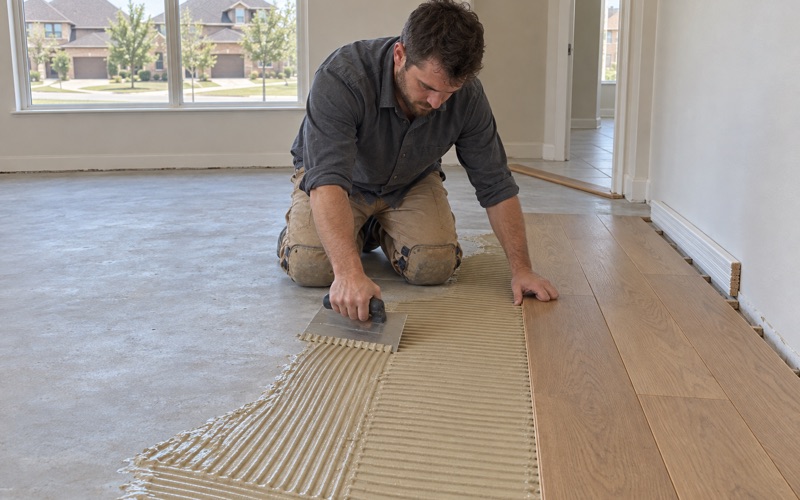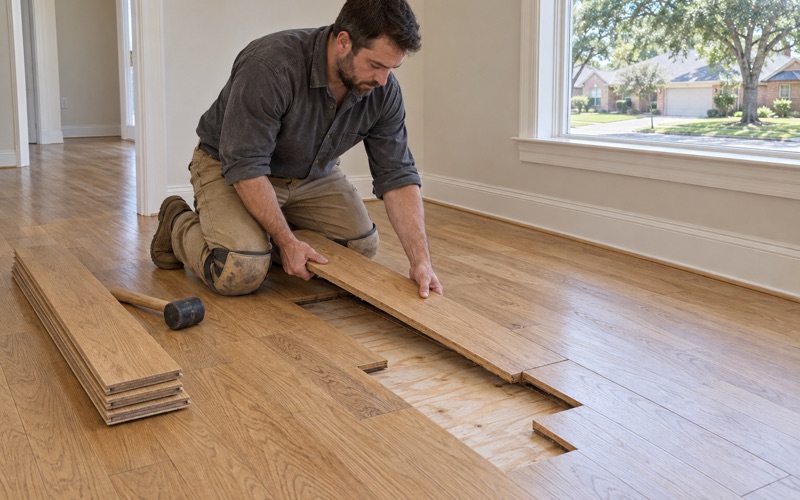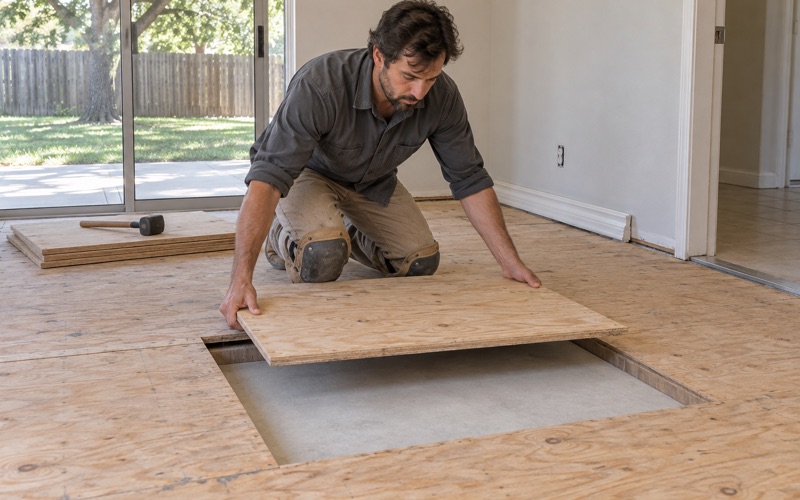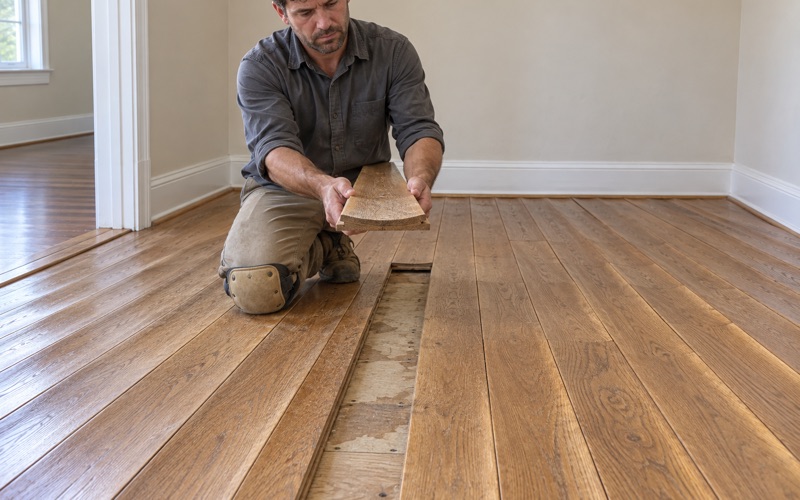
North Richland Hills Wood Flooring installs, sands and refinishes wood flooring in Keller, and we have spent more than twenty years doing that work in Tarrant County. Most of it happens in houses whose owners are hiring a flooring contractor for the first time in their lives. The first questions we get are almost never about species or sheen.
They are about how to tell a real flooring contractor from a truck with a sander in the back of it. Texas does not answer that question for you. The state issues no license for flooring installation or refinishing, so there is no license number to look up and no state board standing behind the trade.
Keller closes part of that gap at the city level, and it does it before a crew ever sets foot in your house. Knowing what the city asks of a contractor gives you a verification step to use where a license would normally sit, and it changes how a bid here should be read.
What Texas does not license, and what Keller requires instead

Flooring sits outside the state licensing system in Texas. Electricians, plumbers and air conditioning contractors carry state licenses; a hardwood installer does not, and neither does a refinisher. That is not a loophole anyone is exploiting; it is simply how the statute is drawn, and the practical effect is that the first check most homeowners reach for does not exist.
The city fills part of that space. Under the City of Keller Code of Ordinances, Chapter 4, Buildings, all general contractors, contractors of the major trades and contractors holding state licenses must register with the city before starting any work. Registration is not a skills test and nobody should sell it to you as one. It is a record that a named business has identified itself to the city and met the city’s conditions before working here.
The coverage line behind the registration
The condition with real weight is financial. A contractor registering with Keller must provide a copy of liability insurance or a surety bond in the amount of $300,000 per occurrence. Per occurrence means per incident, not per year and not spread across a season of jobs.
That figure matters to a flooring customer in a specific way. Sanding and finishing put heavy machines, solvents and airborne dust into an occupied house, and the ways a floor job can go wrong tend to be expensive rather than cheap. The registration requirement means the money behind a mistake was arranged before the job started rather than argued about afterward.
The offices behind it
City of Keller Building Inspections is the department on the building side of all this, and it works from a current code baseline. Keller adopted the 2021 International Residential Code with an effective date of February 25, 2022, along with the rest of the 2021 International Codes, the 2018 International Energy Conservation Code and the 2021 International Fire Code with appendices. Tarrant County records the property and the Tarrant Appraisal District values it.
None of those offices will tell you whether a flooring crew is any good. That is the honest limit of what a registration system does, and homeowners who expect more from it end up disappointed in the wrong direction.
Looking for wood-flooring closer to Southlake? See Wood-Flooring in Southlake.
What you can verify, and what you still have to judge
Ask for the registration, then ask who is actually on the job
A registration attaches to a business. It does not travel with a subcontractor onto your job, and sanding is the portion of a hardwood job most often handed to somebody else. Ask who will be running the drum sander and the edger inside your house, and whether that person works for the company whose name is printed on the bid.
Our answer to that is the same every time. We run one crew from tear-out to the final coat and never subcontract the sanding, because the people who pulled the old covering up already know what the subfloor did when they got there. Handing that off halfway through a job is where the thread gets lost.
Coverage that is current on the day the machines arrive
A certificate of insurance is a snapshot of one day. Policies lapse, get replaced and change limits, and a certificate handed over in March proves very little about a job that starts in September. Ask for a current copy rather than a filed one, and ask that it describe the work actually being done.
The payment schedule deserves the same scrutiny. A deposit that covers material with the balance due at completion is ordinary, and a change-order clause requiring your signature before any extra work begins is a good sign. A demand for most of the money before anything arrives leaves you with no leverage if the job stalls halfway through.
What registration cannot answer
Registration says nothing about whether a crew has sanded a floor like yours. It does not speak to whether a bid is priced honestly or whether the finish schedule suits a house with kids and a big dog in it. Treat it as the floor of the vetting process, not the whole of it.
Reading a flooring bid without a license to lean on
With no state credential in play, the bid document itself becomes your strongest evidence. A bid written by somebody who does this work every week reads differently from one written by somebody guessing at it, and the tell is almost always specificity.
Line items that name a product and a number
A serious scope names the species and grade. White oak at 1360 Janka takes wear differently than red oak does, and hickory at 1820 Janka is harder again and correspondingly harder to sand flat. The scope should say whether the floor is site-finished or prefinished, and it should name the finish itself: waterborne polyurethane, oil-modified polyurethane or a hardwax oil, with the number of coats and whether a sanding sealer goes down first.
It should also name the abrasive sequence. A 36-50-80 grit sequence with an edger and a buffer behind it is an ordinary path for a solid floor, and a line that reads only “sand and finish” is a line you cannot compare against a second bid.
Stairs are the item left vague most often. Treads, risers, nosing and any baluster that has to come out and go back are separate pieces of labor, and a staircase folded into a square-foot number tends to reappear as a revision. Doorways work the same way, where a reducer, a T-mold and a threshold are three different details at three different prices.
Moisture, before a date goes on the calendar
Slab moisture is the one number we record before an installation date gets set, rather than after the material is already stacked in your driveway. An ASTM F2170 in-situ relative humidity test or a calcium chloride test produces a figure that can be written down and referred back to later. A schedule built on a number holds up better than one built on a guess about the weather.
Wood then acclimates inside the house, in the room it is going into, never in the garage and never left on the truck. Ask any bidder where the material will sit and for how long. The answer tells you whether the schedule was built around the floor or around the crew’s calendar.
Repair, refinish, replace, priced in that order
We price those three in that sequence and name the cheaper option first whenever it is the right one. A screen-and-recoat on a floor whose finish is tired but whose wood is sound costs a fraction of a full sand, and a board replacement or a weave-in is often all a damaged patch actually needs. A bid that goes straight to replacement without pricing the two cheaper answers has skipped a step you paid for.
Scope, prep and warranty language that tells you who you are dealing with
Keller is an owner’s market rather than a manager’s one: 13,556 of its housing units are owner-occupied single-family detached houses in the ACS 2024 five-year estimates, table B25032. An owner living in the house is the person who later notices overwood at a threshold, a squeak that came back, or a finish that never quite hardened. That is why the written scope matters here more than the sales conversation does.
Prep decisions belong in writing
Ask what happens if the subfloor is not flat once the old covering comes off. Self-leveling underlayment, expansion gaps at the walls and transition track anchoring at doorways all carry cost, and prep left unnamed in a bid has a way of reappearing as a change order.
Dust is the other prep item worth pinning down. We set up dustless containment on every sanding job and show it to you before the first machine runs, which is a different promise from a line item that says dust will be minimized.
Sequence around the rest of the house
A floor installed ahead of foundation work or plumbing repairs is paying for somebody else’s schedule. We sequence behind both, even when that means a later start date, because the alternative is sanding a floor twice.
Housing age shapes what we find underneath. Only 132 housing units in the entire city predate 1960, so framed floor systems from the pre-slab era are rare here, even in Old Town Keller on the western edge of town where the street names of the original forty-acre townsite survive.
Cure time is not dry time
A written cure and occupancy schedule goes out before the first coat is applied. It says when the floor can be walked on in socks, when furniture is allowed back, and when the dog is allowed back, because those are three different dates. Dry time and cure time are separate numbers and confusing them is how a new finish picks up its first permanent marks.
Warranty language deserves the same reading. A warranty that names the finish, the coats and the conditions it depends on is a warranty somebody intends to honor, and one written in generalities usually is not.
If you are collecting bids for wood flooring in Keller, start with what the city already gives you. Confirm the Chapter 4 registration, look at the coverage behind it, then read the scope for products, numbers and sequence. We are happy to be read that way.
- 20+ Years Experience
- Dustless Containment
- Free Written Estimates