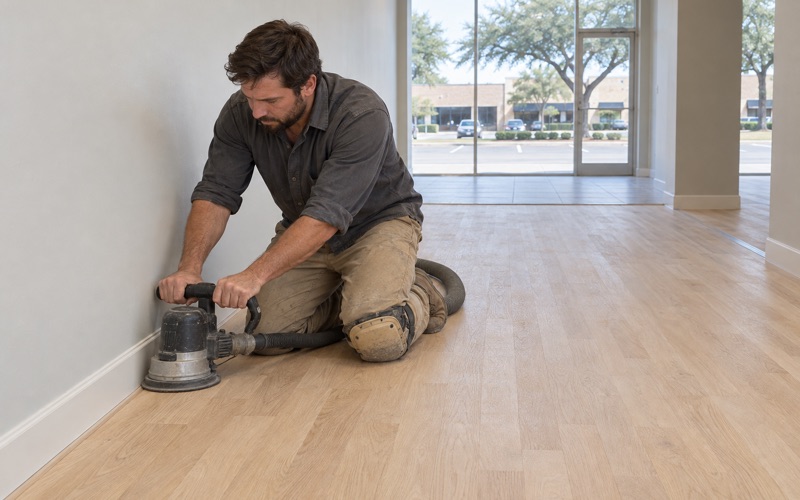
North Richland Hills Wood Flooring has spent more than 20 years on wood-flooring work in Highland Village, and most of what we are called out to look at is not a new floor. It is a solid floor with a finish history already behind it, and the question on the table is whether it can take another sand.
The only honest way to answer that is to measure the sound wood left above the tongue before we write the quote, not after the first cut has told us. A number taken at the start changes what we recommend and what we charge; a number discovered mid-job turns the job into an argument. So we take the reading first, in front of you, and we say plainly what it means.
From there we price repair, refinish and replacement in that order, and we name the cheaper option first whenever it is the right one. Sometimes that means talking a customer out of a full sand they had already decided to pay for. That is not modesty about the work; it is the difference between a floor that has another pass in reserve and one that runs out of wood early.
What the housing record says about floor age here
Highland Village counts 5,680 housing units, and 2,156 of them, 38.0%, were built before 1990. The largest part of that group is the 1,215 units built between 1980 and 1989, followed by 941 built between 1970 and 1979, with 130 units older than 1970. Those counts come from the 2024 five-year American Community Survey, table B25034, read through Census Reporter.
That puts the largest pre-1990 group somewhere between 36 and 55 years old. The modal decade is later, the 1,592 units of the 1990s, but age is not spread evenly across a city and a quote has to match the house in front of it rather than the average.
Why the 1970s and 1980s cohort matters for a sand
A house from those two decades was very likely floored with solid tongue-and-groove strip, nailed down and finished on site. That construction is the reason a refinish is on the table at all: there is real wood above the tongue, and a machine can take some of it. It is also the reason the wood is finite, because every pass that has already happened came out of the same budget.
We do not assume how many of those passes a given floor has had. A floor that reads as heavily worn may have been refinished once and abused since; a floor that looks tired may still carry its original finish and need nothing more than an abrasion and a coat. The count is something we measure, not something we guess at from the doorway.
The houses older than 1970
The record counts 130 units built before 1970, and the city itself was incorporated February 14, 1963, with a 1970 population of 516 against 15,899 at the 2020 census. The oldest housing here is a small share of the stock, but it is the share where lead-safe work practices govern how we set up.
Every one of those pre-1970 houses is pre-1978 housing, and the 1970s cohort straddles that date. Sanding is precisely the activity the EPA RRP lead-safe rule at 40 CFR 745 Subpart E was written around, so on any house built before 1978 we run containment and cleaning verification as part of the job rather than as an upsell. That holds whether we are taking a whole floor to bare wood or cutting out a short run of boards.
Looking for wood-flooring closer to Azle? See Wood-Flooring Services in Azle.
Measuring what is left above the tongue
The measurement that decides everything is the thickness of sound wood sitting above the tongue of the board. Below that line you are into the tongue itself and the nailing area, and a floor that reaches it is finished as a sandable floor. Everything we quote on a refinish comes back to that one dimension.
Where the reading is taken
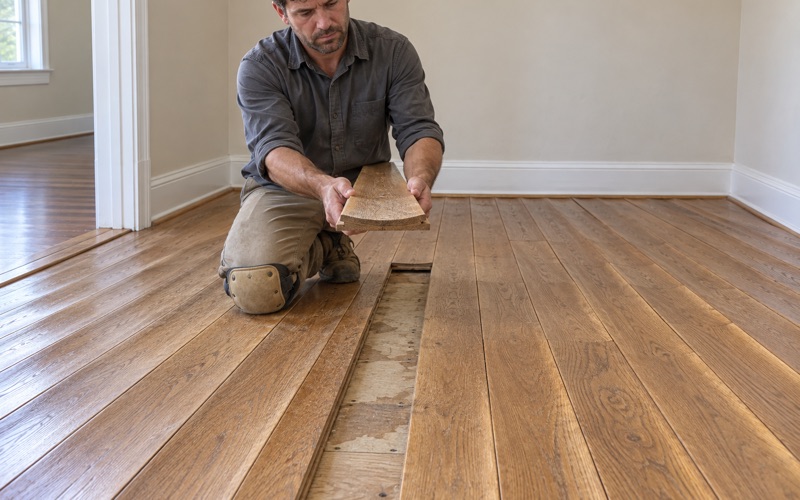
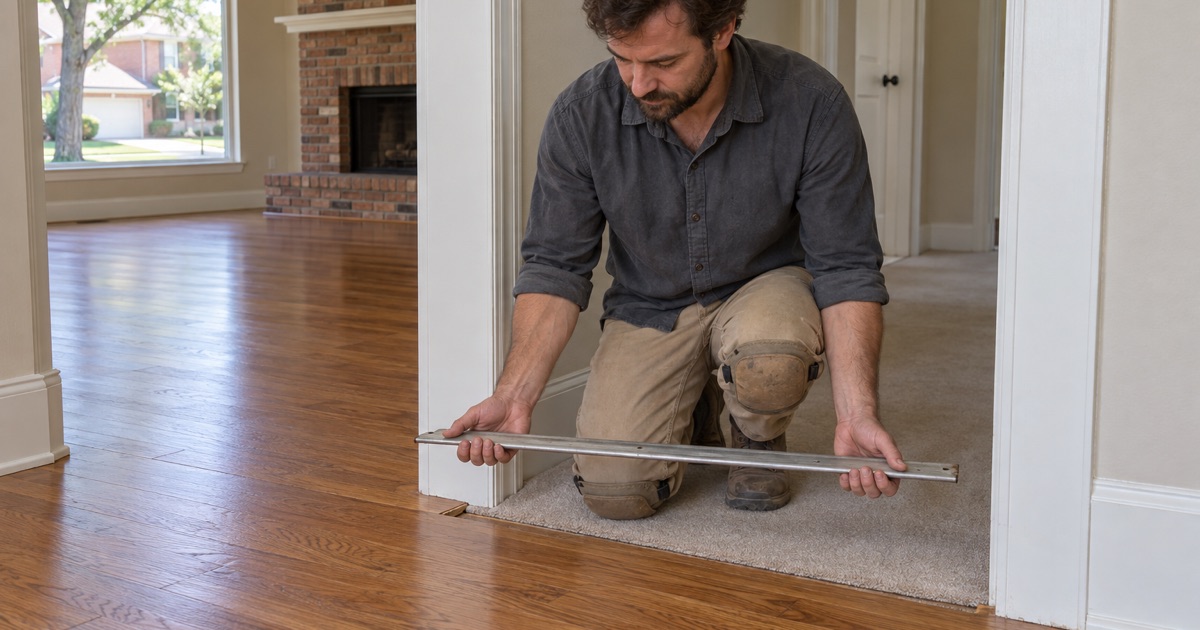
We expose an edge rather than estimate one. A floor register, a threshold at a doorway, a board lifted inside a closet, or the run of flooring under a transition track will all show the full section of a board, and a caliper on that edge gives a real number.
One reading is not enough, because previous refinishes were rarely uniform. Traffic lanes, the top of a stair landing and the first few feet inside an exterior door usually carry more history than a bedroom corner, so we take readings across the run and quote from the thinnest one.
The three things that stop a sand
Nail heads are the first. Cleats or staples driven through the tongue sit just under the nailing area, and once a drum sander or an edger reaches them the floor is done: the machine takes damage, the abrasive tears, and boards start to move because the fastener no longer has wood around it.
Remaining thickness above the tongue is the second, and it is the only one of the three that can be known before anybody signs anything. Sand-through is the third: cut past the tongue on a solid board and the joint holding the floor together is gone, which makes it a repair rather than a finish.
What the reading changes
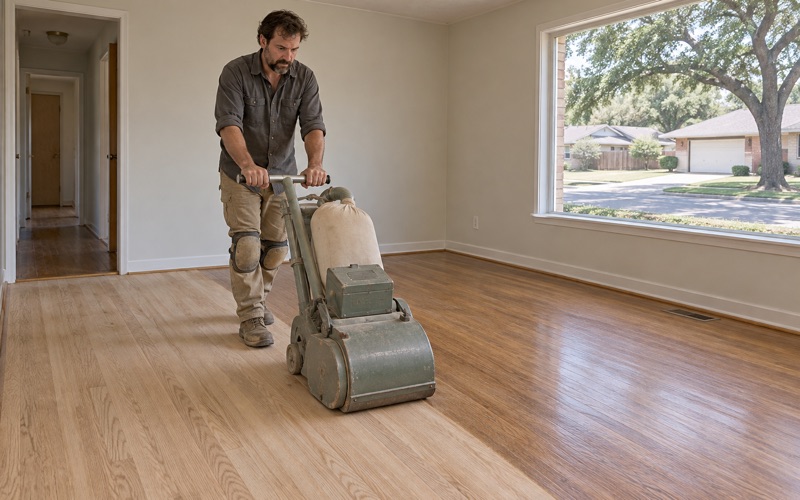
A floor with real thickness left can take a full 36-50-80 grit sequence, a drum sander through the field, an edger at the perimeter and a buffer before finish. A floor near its limit gets a lighter cut, a finer starting grit, or no cut at all.
We put the number in the quote in writing, along with what we think it leaves for the future. An owner who knows the floor has one full sand remaining makes different decisions about finish, about rugs and about when to call us next than one who was simply told the floor is fine.
When a screen-and-recoat beats a full sand
A full refinish is the expensive option and the irreversible one, and a good share of the floors we look at do not need it yet. A screen-and-recoat abrades the existing finish, removes no measurable wood, and puts a fresh coat over the top.
What a recoat fixes and what it does not
It handles a finish gone dull, surface scuffing, traffic paths and the general haze of a top coat that has worn thin but not through. It is a same-week job, it costs a fraction of a sand, and it leaves the sanding budget untouched for the day the floor genuinely needs it.
It does not fix a stain that has reached the wood, a gouge deep enough to catch a fingernail, gray boards where the finish failed years ago, or cupping and crowning driven by a moisture problem that is still active. Those need wood removed or wood replaced, and a coat laid over the top of them just seals the problem in under a shine.
Finish, cure and getting the house back
We work with waterborne polyurethane, oil-modified polyurethane and hardwax oil, chosen for the floor, the color you want and how quickly you need the house back. The federal AIM rule at 40 CFR 59 Subpart D caps the solvent content of these products, which is part of why a modern waterborne finish behaves differently from what went onto a 1980s floor.
Cure time and dry time are not the same thing, and the gap between them is where good work gets ruined. You get a written cure and occupancy schedule before the first coat goes down, covering when furniture comes back, when rugs can go down, and when pets are allowed on the floor.
Dustless containment goes up on every sanding job, and we set it up and walk you through it before a machine runs. One crew handles the work from tear-out to final coat and the sanding is never subcontracted, because the person taking wood off the floor should be the person answering for how much is left.
Codes, sign-off and the case for replacement
Highland Village has adopted the 2015 International Mechanical Code, the 2015 International Plumbing Code, the 2015 International Energy Conservation Code and the 2015 International Existing Building Code, each as amended locally, along with the 2014 National Electrical Code as amended. Those editions reach a flooring job mostly at its edges, where a floor meets a water heater pan, a supply line, a return duct or a hearth.
Who to ask
City of Highland Village Building Inspections is the authority on how the city’s rules apply to a given scope of work, and that is a question we take to them rather than answer from the truck. Denton County is the county of record, and Denton Central Appraisal District carries the year-built figure most owners quote to us.
An appraisal record is a useful starting point for a conversation about age, but it is not a measurement of a floor. We have taken readings in houses whose paperwork and whose remaining thickness told two completely different stories.
An owner-occupied, detached market
The record counts 5,446 of 5,680 units as single-family detached, 95.9%, and 5,098 of the 5,548 occupied units as owner-occupied, 91.9%. That shapes who we are talking to here more than anything else in the data: the person deciding about the floor is usually the person who will still be standing on it years from now.
It also means very little of this work is a turnover racing a deadline somebody else set. A schedule can be built around cure time and around the house staying livable, which is the main reason we can recommend the slower, cheaper option without it costing anyone their calendar.
When replacement is the honest number
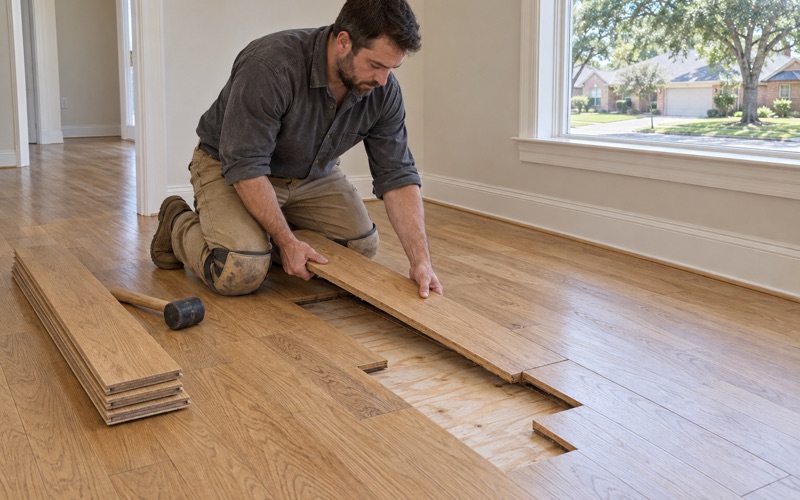
When the reading says there is nothing usable left above the tongue, or when fastener heads are already showing in the traffic lanes, we say so and price replacement instead of selling a sand that will fail. Often that is local rather than whole-house: board replacement, a weave-in or lacing into the existing field, or a dutchman patch where something was cut for a vent or for a wall that has since moved.
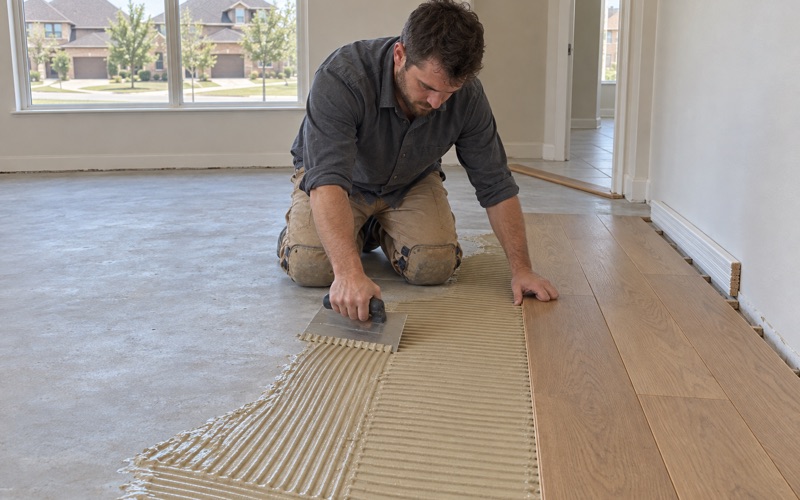
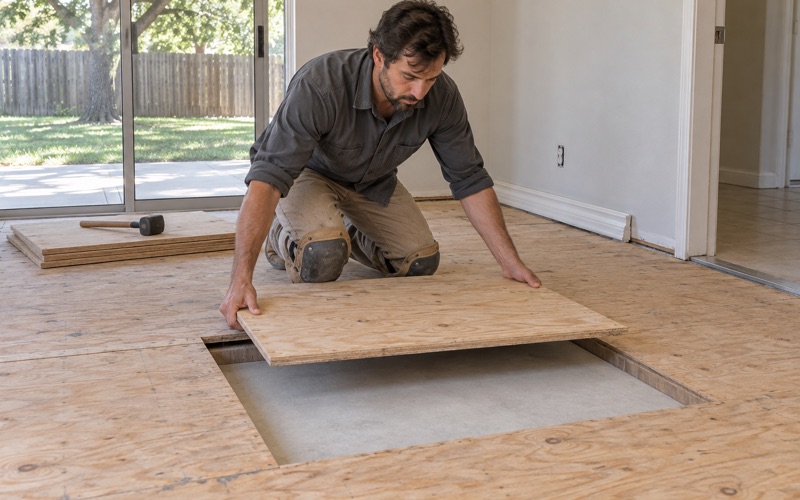
On a full replacement the slab comes first. We test slab moisture to a recorded number before an installation date is set, rather than after the wood is already sitting in the house, and we identify whether the slab is post-tension or conventionally reinforced before anything is fastened into it, because that answer decides the installation method instead of habit deciding it.
Wood acclimates inside the house, in the room it is going into, never in a garage and never on a truck. We also sequence the floor after foundation repair and plumbing rather than ahead of them, so a new floor is not paying for somebody else’s schedule.
- 20+ Years Experience
- Dustless Containment
- Free Written Estimates