North Richland Hills Wood Flooring installs, sands and repairs wood flooring in Grapevine, Texas, and we have been doing that work for more than twenty years. A large share of it arrives through someone who will never walk on the finished floor: an owner holding a lease, a property manager, a leasing agent working a turn between tenants. The specification, the schedule and the invoice all sit with that person, and the floor still has to survive whoever moves in next.
That changes the questions worth asking before a single board is cut. An owner-occupant asks what the floor will look like in the living room on a Sunday; an owner holding a leased unit asks how the same floor sands out in four years, what one damaged run costs to fix, and whether the crew can be finished before the date already on the calendar. We price and schedule for both, and we say plainly which kind of job a job is.
Everything below is written around how the work actually runs at this end of Tarrant County. That means what a durable specification looks like, how a vacancy window gets used, when a repair beats a replacement, and which office the finished work answers to.
Almost half of Grapevine’s occupied homes are leased
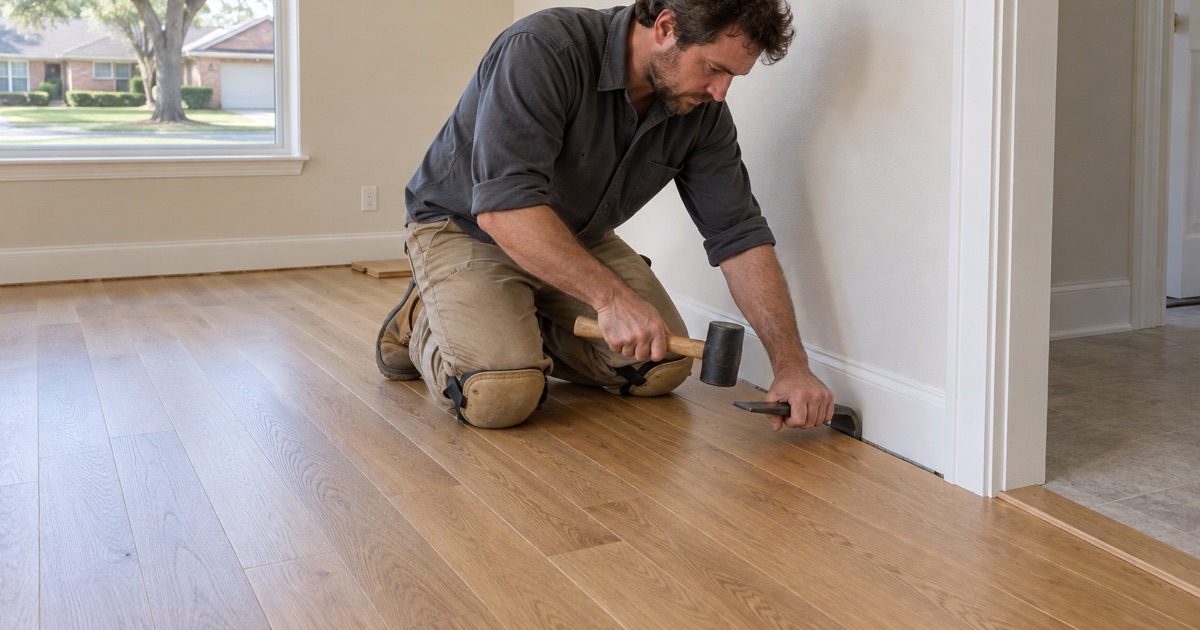
Grapevine’s occupied housing splits close to evenly between owners and tenants. The ACS 2024 five-year estimates record 10,211 of 21,593 occupied units as renter-occupied, or 47.3%, against 52.71% owner-occupied. A market shaped like that is not a landlord market or a homeowner market; it is both at once, and a flooring crew that only knows how to work one of them is guessing half the time.
The building stock behind those numbers
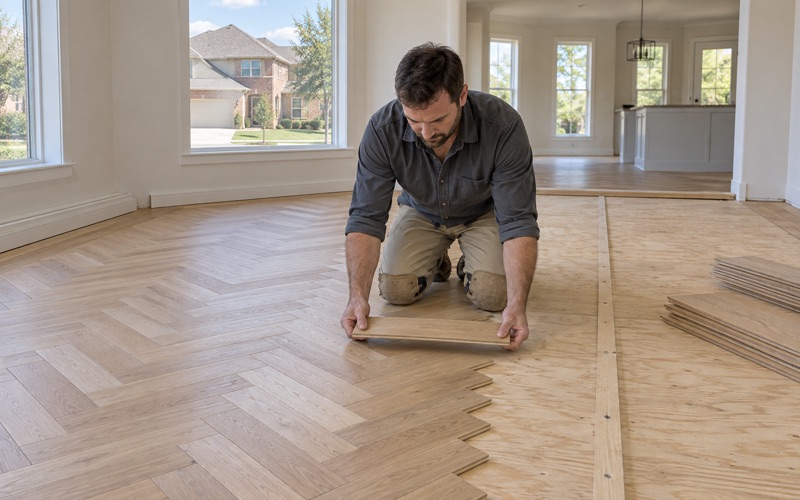
Single-family detached units account for 53.70% of the city’s 22,885 housing units, 12,289 in all, and 10,563 detached units are owner-occupied. Detached construction is the dominant building type here, which usually means stairs, hallways and continuous runs between rooms rather than a single room’s worth of board footage. We plan scope around that layout, because a continuous floor cannot be phased room by room the way a set of separate rooms can.
Who is on the other end of the quote
On an owner-occupied job we are talking to the person who will live on the floor. On a leased unit we are usually talking to a manager holding a portfolio, who needs a number, a date and a finished condition, in that order. We quote those jobs the same way we quote any other, and we carry the same specification across a portfolio so the fourth unit does not have to be re-explained from the beginning.
Repeat work also changes what a quote has to contain. When the same species, the same wear layer and the same finish system go into unit after unit, a later repair matches instead of announcing itself, and nobody has to re-decide a settled question at every turn.
Neither side of that market gets a different crew. One crew stays on the job from tear-out to final coat, and the sanding is never subcontracted out.
Looking for wood-flooring closer to Haslet? See Wood-Flooring in Haslet.
What a landlord is actually buying in a hardwood floor
A floor bought for a leased unit is bought for its second and third tenancy, not its first. That pushes the specification toward species hardness, wear layer and how the floor behaves under a repair, and away from whichever board looked best under showroom lighting.
Species and hardness
The Janka hardness rating is the usual starting point. White oak sits at 1360 and hickory at 1820, while red oak and maple are the other two species that come up constantly in this market. Harder is not automatically better, since a harder board is also harder to sand and to match later, but hardness is a number worth knowing before an order goes in.
Wear layer decides whether a refinish exists at all
On engineered flooring the wear layer is the whole question. We measure it before quoting a refinish, because under about three millimeters there is nothing left to sand, and a drum sander on a two millimeter wear layer produces sand-through to the plywood core rather than a refinished floor. A six millimeter wear layer is a different asset: it can be screened, recoated and eventually sanded across more than one tenancy.
The slab under the product
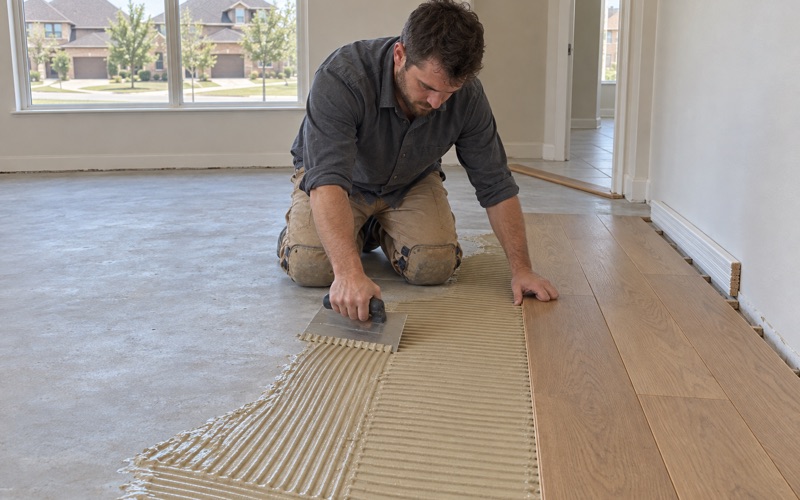
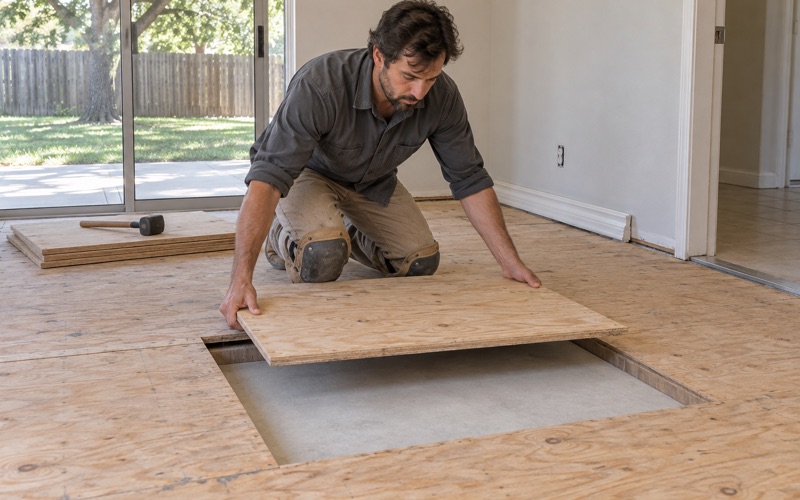
What can go down at all depends on what is underneath it. We test slab moisture to a recorded number before an installation date is set rather than after the wood is already on site, using an in-situ relative humidity test to ASTM F2170 or a calcium chloride test, and we identify whether the slab is post-tension or conventionally reinforced before anything is fastened into it. A post-tension slab rules out driving fasteners into the concrete, so the installation method follows that answer instead of habit.
The largest single decade of building here is the 1980s, at 6,617 units or 28.9% of the stock. Slab-on-grade is the ordinary condition through that era, which is why the moisture number and the slab type are the first two things we establish rather than the last.
What actually fails on a leased floor
Most of what we get called back to fix is predictable. The recurring items are water at the dishwasher and the refrigerator line, cupping and crowning where a floor took on moisture and dried unevenly, seasonal gapping through a dry winter, and bond line failure or hollow spots under a glue-down engineered floor that went over a slab nobody tested. None of that is exotic, and most of it is cheaper to design against than to repair twice.
Working inside a vacancy window
A vacancy window is a fixed number of days between one tenant handing back keys and the next one taking them. Flooring is often the longest-duration trade inside it, and it is the one that cannot be compressed at the end, because a finish that is dry is not the same as a finish that has cured.
Scheduling backward, not forward
We schedule rental turnovers backward from the inspection or move-in date rather than forward from ours, so the unit is finished when it has to be finished. The moisture reading, the acclimation period and the coating schedule go onto the calendar first, and the start date falls out of them. When those days do not fit the window, we say so before anyone commits, which is considerably cheaper than saying it on day four.
Acclimation and the cure schedule
Wood acclimates inside the house, in the room it is going into, never in the garage and never left on the truck. Before the first coat goes down we hand over a written cure and occupancy schedule, including when furniture and pets come back. On a turn that schedule is the document the rest of the make-ready gets planned around.
The sanding sequence does not compress
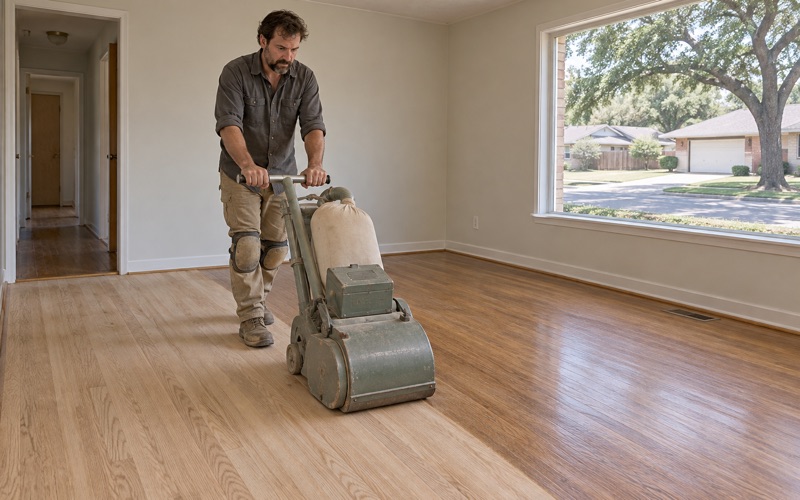
A full sand runs a 36-50-80 grit sequence, with a drum sander through the field, an edger at the perimeter and a buffer before coating, and each pass has to remove the scratch pattern the pass before it left. Skipping a grit to save half a day shows up in the finish under raking light, which on a turn means a tenant walking in on a floor that looks worse than the one they were shown. The sequence takes the time it takes, and we build the window around that.
Sequence, containment and older houses
Flooring gets sequenced after foundation repair and plumbing work rather than ahead of it, so a new floor is not paying for another trade’s schedule. Every sanding job runs under dustless containment, set up and shown to you before the first machine runs. On any house built before 1978 we use lead-safe work practices, including containment and cleaning verification, because sanding is precisely the activity that rule addresses.
Repair, documentation and who checks the work
Replacement is the most expensive answer to a damaged floor and usually the least necessary one. We price repair, refinish and replace in that order and name the cheaper option first whenever it is the right one, which compounds across a portfolio in a way it never does on a single house.
Fixing a run instead of pulling a floor
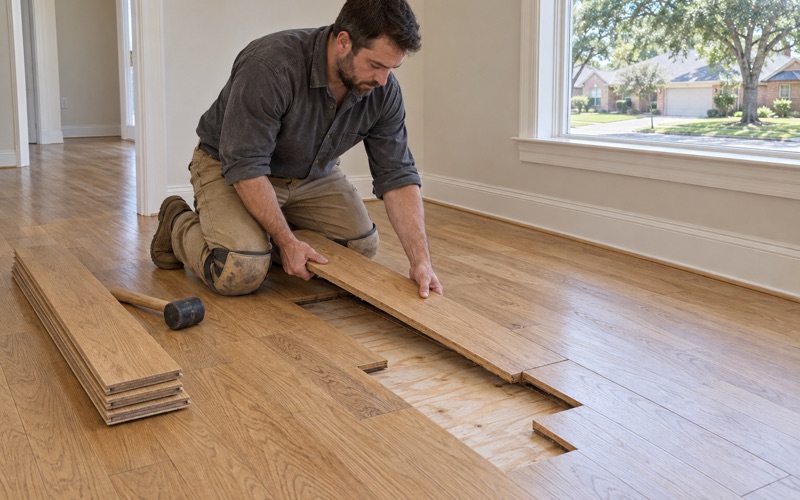
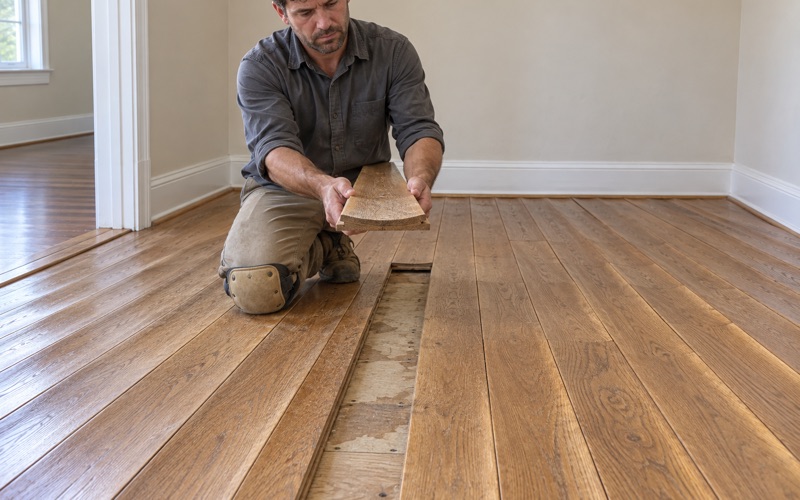
A gouged or water-damaged section is often a board replacement problem: cut the damaged boards out, weave in replacements so the joints stagger the way the original run does, and sand the repair into the surrounding field. Lacing a new run into an old one is a different job from laying a new floor, and it is priced that way. A screen-and-recoat between tenancies, where the finish is worn but the wood underneath is sound, buys years on a floor for a fraction of a full sand.
Condition documentation between tenancies
On a turn, the useful record is the one made before the work starts. We photograph the floor room by room, take moisture readings and note existing cupping, gapping or overwood, so the condition at handover is documented rather than remembered. Where water is involved we document the damage the same way for the claim file, room by room, with photographs, moisture readings and a line-of-sight map.
Codes and the local authority
City of Grapevine Building Services is the building code authority for an address in this city, and Grapevine adopted the 2021 International Building, Residential, Plumbing, Mechanical, Fuel Gas and Fire Codes along with the 2020 National Electrical Code, effective January 1, 2024. We confirm the scope of a job with that office before a date is set rather than assuming what applies to it. Tarrant County is the county of record, and unit-level property detail sits with the Tarrant Appraisal District.
Materials carry their own rules. Waterborne and oil-modified polyurethane are regulated for VOC content under the federal AIM rule at 40 CFR 59 Subpart D, and the engineered products we install are made to the TSCA Title VI formaldehyde standard at 40 CFR 770.
- 20+ Years Experience
- Dustless Containment
- Free Written Estimates