North Richland Hills Wood Flooring has been doing wood-flooring in Farmers Branch for more than twenty years, and on a refinish here the first thing we settle is not the stain color. It is the year the house was built. That single answer decides which rulebook the sanding runs under.
Two separate sets of rules reach a floor at this address, and neither is the one most homeowners expect. The city is enforcing a construction code package it enacted several years ago while a newer package sits waiting, and the federal lead-safe renovation rule keys off a build year and waits on no council vote at all. One of those you can look up at City Hall; the other applies whether anyone looks it up or not.
We put both on the table before quoting, because between them they set the containment we build, the sequence we work in, and what we are accountable for cleaning up at the end. None of it changes how the finished floor looks. All of it changes how we get there, and what a straight quote has to include.
Sanding a floor built before 1978 is regulated renovation
The EPA’s Renovation, Repair and Painting rule, 40 CFR 745 Subpart E, governs work that disturbs painted surfaces in housing built before 1978. Sanding is close to the rule’s central example of a disturbance: a drum sander takes off finish, and whatever else is bonded to the surface, and puts it into the air of a closed room. Nothing about that depends on a municipal decision. If the house predates that cutoff, the rule is in force.
The six square foot minor repair threshold
The rule carves out an exemption for interior minor repair and maintenance, set at six square feet of disturbed painted surface per room. That number is the entire argument on a flooring job, because it is a small area. Scraping back a single door casing can approach it. A floor is a far larger surface than that before the edger has run at all.
So we do not treat the exemption as a live option on a room sand or a whole-house refinish. We plan the job as regulated renovation whenever the build year says it is, and we establish that year first rather than last. The exemption mostly tells you about scale: the threshold was written for patch work, and refinishing is not patch work.
Why flooring work sits inside the rule
Flooring touches painted surfaces even when nobody sets out to. Base shoe and baseboard come off for a full sand and go back afterward, and the edger runs hard against painted trim down the length of every wall. Stair treads, risers and stringers are painted more often than not, and a stairway refinish disturbs all three. Board replacement, a weave-in at a doorway or a dutchman patch each open up trim and threshold details that were painted at some point in the house’s life.
None of that is a reason to avoid refinishing an older floor. It is a reason to know before the quote whether the job is a contained one, because containment is labor and labor is money, and finding out on day two is worse for everyone. A quote that ignores the question is not cheaper; it is just less finished.
Looking for solid hardwood flooring closer to Carrollton? See Solid Hardwood Flooring in Carrollton.
Establishing the build year for your address
None of this can be settled from a citywide statistic, and the published statistics do not even use the rule’s cutoff. The American Community Survey reports build era as before 1980, not before 1978. A two-year mismatch is nothing across a whole city and decisive for one house.
What the citywide counts do and do not tell us
The counts for Farmers Branch record 13.2% of units as predating 1960 and 61.3% as built during 1980 or later. Those shares describe a housing stock; they do not describe an address, and no homeowner can read their own house out of them. What they tell us is what to expect as a crew: work here lands on both sides of the 1978 line often enough that we never assume either one. The share is a planning number for us and not an answer for you.
The older part of that record is concentrated in two decades: 2,126 units built during the 1950s and 3,083 during the 1960s, 5,209 combined. Those units sit on conventionally reinforced slab-on-grade rather than post-tension slab, and they carry the narrow-strip hardwood, subfloor and trim details of that period. Knowing a house belongs to that group changes how we lift the old floor, what we expect under it, and how much painted trim has to come off.
The addressable part of the stock is narrower than the total. Of 17,260 total units the record counts 7,328 as single-family detached, or 42.5%, and 5,846 of those as owner-occupied. That is the pool a hardwood refinish usually comes out of, and it is the pool we plan a schedule around.
Where we start looking
The Dallas Central Appraisal District year-built record is the first thing we pull, because it is public, it is per parcel, and it is usually the number an owner or a lender has already seen. It is a starting record rather than the last word. A remodel that replaced trim, a garage conversion or a later addition can put newer painted surfaces into an older house and older ones into a newer one. Records also get corrected, and the correction does not always reach every copy.
So we read the house alongside the record. Cut nails under the boards, the width and species of the original strip flooring, how the base is assembled and whether the trim has been replaced all say something about age. When the house and the record disagree, we resolve it before the machines come off the truck.
What Farmers Branch enforces now, and what is still pending
The building code authority for this city is the City of Farmers Branch Community Services Department. What that department enforces today is the 2018 International Code Council construction codes and the 2020 National Electrical Code with associated city amendments, approved by City Council during December 2019 and enacted January 1, 2020. That is the package in force, and it is the one a contractor working here should be reading.
The 2024 package that has not been adopted
A package adopting the 2024 ICC model construction codes and the 2023 National Electrical Code was placed on the City Council agenda as a study session item on August 19, 2025. It is Ordinances 3943 through 3953: 3943 (IBC), 3944 (IRC), 3945 (IFC), 3946 (NEC), 3947 (IECC), 3948 (IEBC), 3949 (IFGC), 3950 (IPC), 3951 (IMC), 3952 (ISPSC) and 3953 (IPMC). The Legistar record for that item, printed September 13, 2026, records no final action. Two of those documents would be new to the city rather than a version bump: the International Property Maintenance Code and the International Existing Building Code would be adopted here for the first time under that package.
City staff describe the proposed amendments as reflecting North Texas Council of Governments regional recommendations, addressing Farmers Branch-specific construction conditions, and providing flexibility where appropriate. That is a description of intent, not an adoption.
Why a pending package still matters on a quote
A contractor quoting off whatever model code is newest on the shelf is quoting off a document this city has not enacted. We work from what the Community Services Department enforces now and keep an eye on what is sitting in study session, which is a different habit from assuming the latest edition applies everywhere. The distinction is worth naming out loud, because it is invisible on an invoice.
The federal lead-safe rule sits entirely outside that timeline. It was not part of the study session item, it is not one of the ordinances listed, and a council vote will not move it in either direction. Your build year settles it, and the build year is not up for a vote.
Containment, cleanup and the finish schedule
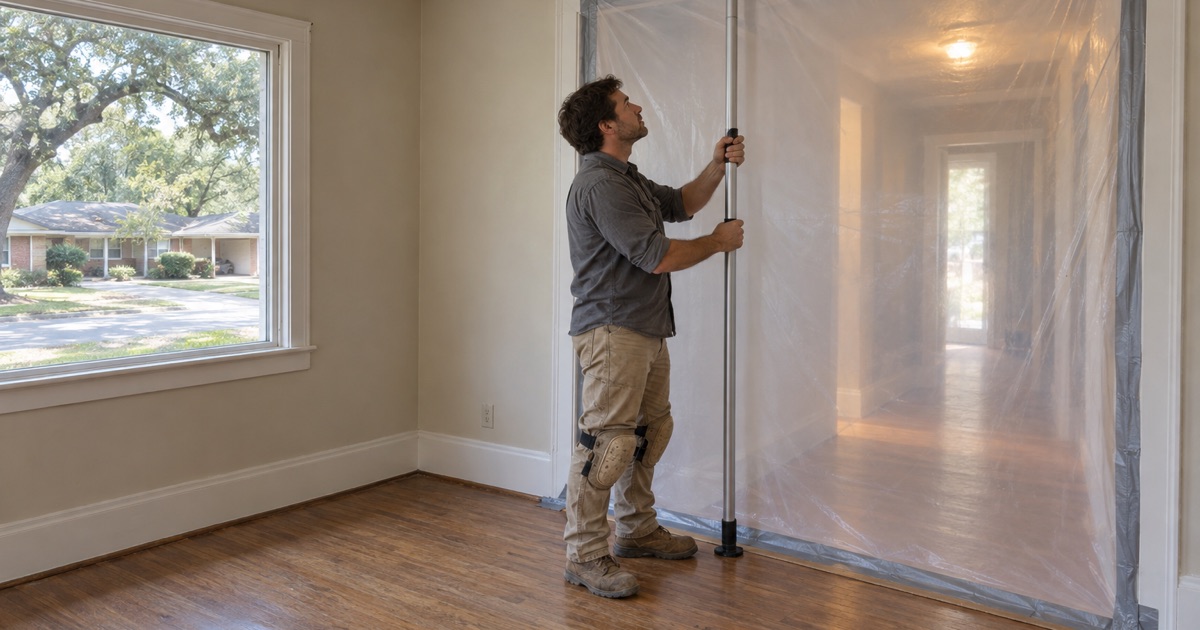
Dustless containment goes up on every sanding job we run, and we set it up and walk you through it before the first machine starts. On a house built before 1978 those same barriers are doing two jobs: keeping the rest of the house clean, and keeping the work area separated for lead-safe practice. The second job is the one with a defined ending.
We follow lead-safe work practices on any house predating 1978, containment and cleaning verification included, because sanding is precisely the activity that rule was written around. Cleaning verification is a step with a defined result rather than a visual once-over, and it is what closes the containment out. You should expect to watch it happen rather than hear that it happened.
What changes on the job itself is mostly sequence and time. Sheeting and a zippered access point go up before anything is torn out, HVAC returns in the work area get closed off, and the crew moves in and out through one controlled opening rather than four doors. Debris is bagged where it falls instead of being carried through the house. None of that is dramatic, and all of it adds hours that belong on the estimate.
A full sand and a screen-and-recoat are not the same disturbance
Not every floor needs to go back to raw wood, and the two jobs are nowhere near equivalent in what they release. A screen-and-recoat abrades the existing finish with a buffer and lays a new coat over it. A full sand runs a drum sander, an edger and a buffer through a 36-50-80 grit sequence and removes the finish entirely. We price repair, refinish and replace in that order and name the cheaper option first whenever it is genuinely the right one.
On engineered flooring we measure the wear layer before we will quote a refinish at all. A six millimeter wear layer behaves like solid wood under a machine, a three millimeter one has a single careful pass left, and under about three millimeters there is nothing to take off without a sand-through to the plywood core. Quoting a refinish on a floor that cannot be refinished is how a job turns into a replacement halfway through.
Cure, occupancy and who is on the job
Waterborne polyurethane and oil-modified polyurethane cure on different schedules, and cure time is not dry time. You get a written cure and occupancy schedule before the first coat goes down, covering when furniture comes back, when rugs can go down and when pets are allowed on the floor. Hardwax oil changes that schedule again, so we hand over the one that matches the finish actually going on your floor.
One crew runs the job from tear-out to final coat, and the sanding is never subcontracted out. That matters most on a contained job, where the people who built the barrier are the people answerable for what happened behind it. We also sequence flooring after foundation and plumbing work rather than ahead of it, so a new floor in Farmers Branch is not absorbing the cost of someone else’s schedule.
- 20+ Years Experience
- Dustless Containment
- Free Written Estimates